More Doesn't Guarantee Better: Why AI Success Depends on Organizational Agility, Not Just the Tech
AI adoption in life sciences is no longer limited by tools. The real constraint is organizational ability to adapt clinical development operating models to continuous change.
Artificial intelligence (AI) is rapidly reshaping clinical development, from protocol design to trial execution and regulatory approval. New tools and capabilities are emerging continuously, creating opportunities to accelerate timelines, improve data quality and streamline workflows. However, across biopharma and life sciences organizations, a consistent challenge persists: AI initiatives demonstrate value in isolated pilots but fail to scale across clinical operations.
This is not due to a lack of technology; many organizations already have access to advanced AI solutions. The underlying constraint lies in how AI adoption is structured, governed and integrated into clinical development processes.
Industry experience shows that AI adoption does not depend on the inclusiveness of an ever-increasing number of AI tools. Instead, organizations should be structured to continuously adapt to evolving capabilities shifting the question of “what can AI do?” to “how must operating models evolve to sustain AI-driven change?”

Explore how aligning governance, processes and technology can unlock sustained value from continuous AI investment.
AI Adoption in Clinical Development: Organizational Agility as the Primary Constraint
Across clinical development and life sciences, a consistent pattern is emerging:
- AI capabilities evolve rapidly
- Internal processes evolve slowly
- Value remains trapped in pilots
The result is an overabundance of proof-of-concepts with limited measurable impact. The underlying issue is structural. SOPs, governance models and approval processes were built for stability and control, not for continuous technological change.
As a result:
- Tools become obsolete before full implementation
- Evaluation cycles outlast relevance
- Scaling efforts stall despite proven value
This is why the real risk is not “keeping up with technology,” but failing to develop the agility required to absorb it.
Why Process-First Models Are Limiting AI Impact
Traditional operating models are based on a clear sequence:
- Define the process
- Document requirements
- Implement technology
- Optimize delivery
This approach works when systems remain stable, but AI disrupts that assumption. Capabilities are advancing faster than these processes can accommodate. By the time workflows are defined and approved, the opportunity has already shifted. The result is a growing disconnect between how organizations operate and what technology enables.
The need to move from a “how work is done” mindset to a “what must be achieved” is emerging as an organizational priority. This shift from procedure-driven to outcome-driven changes how organizations approach the AI adoption process, from designing the solution to implementation.
The AI Agility Maturity Arc: Where Most Life Sciences Organizations Sit Today
To better frame this challenge, consider this AI agility maturity arc with three distinct stages:
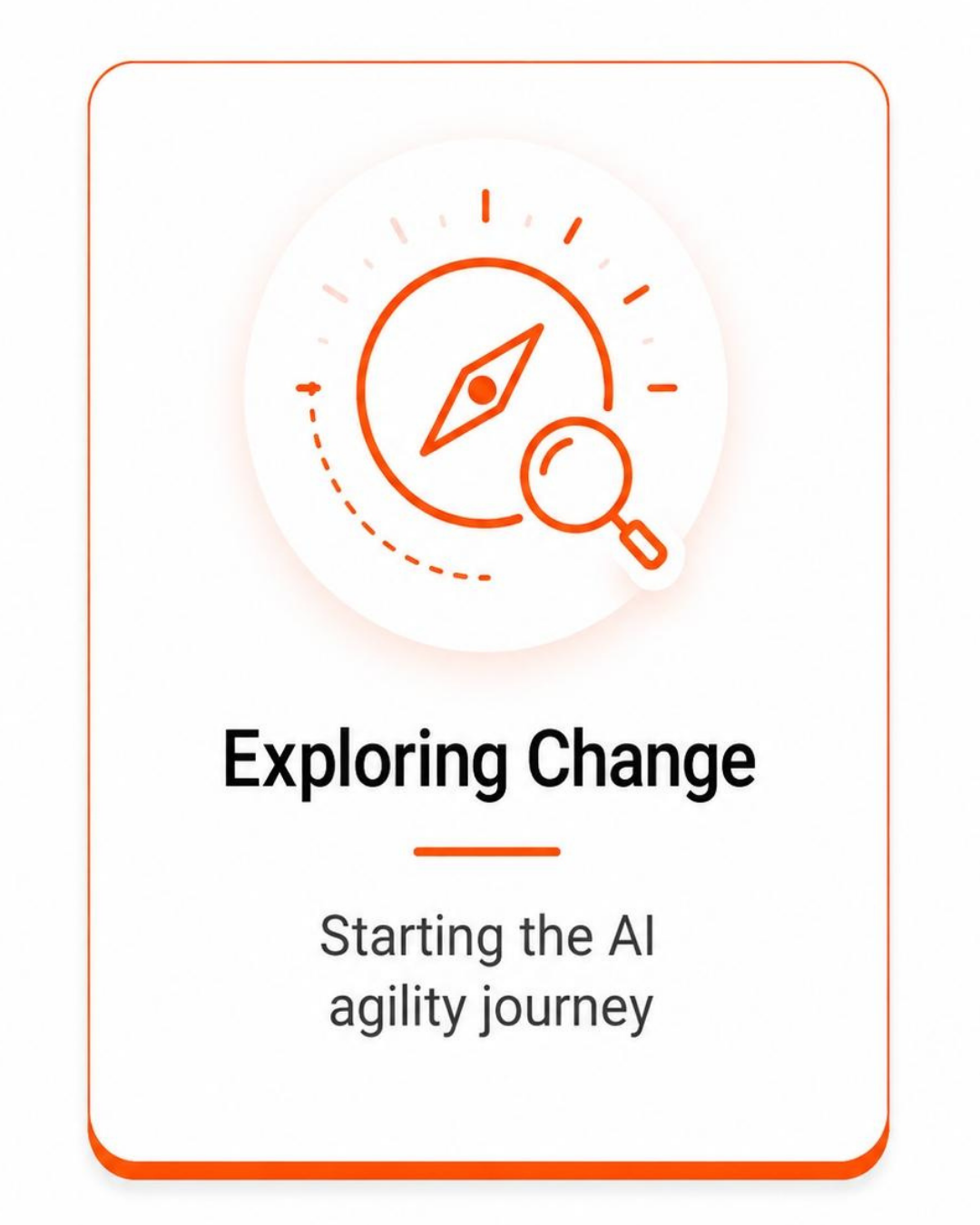
Exploring Change
Organizations begin experimenting with AI but operate without a structured framework:
- Adoption is ad hoc and vendor-driven
- SOPs are rigid and prescriptive
- AI is treated as an add-on capability rather than integrated into delivery
This stage provides stability but creates a high risk of wasted investment and limited scalability.
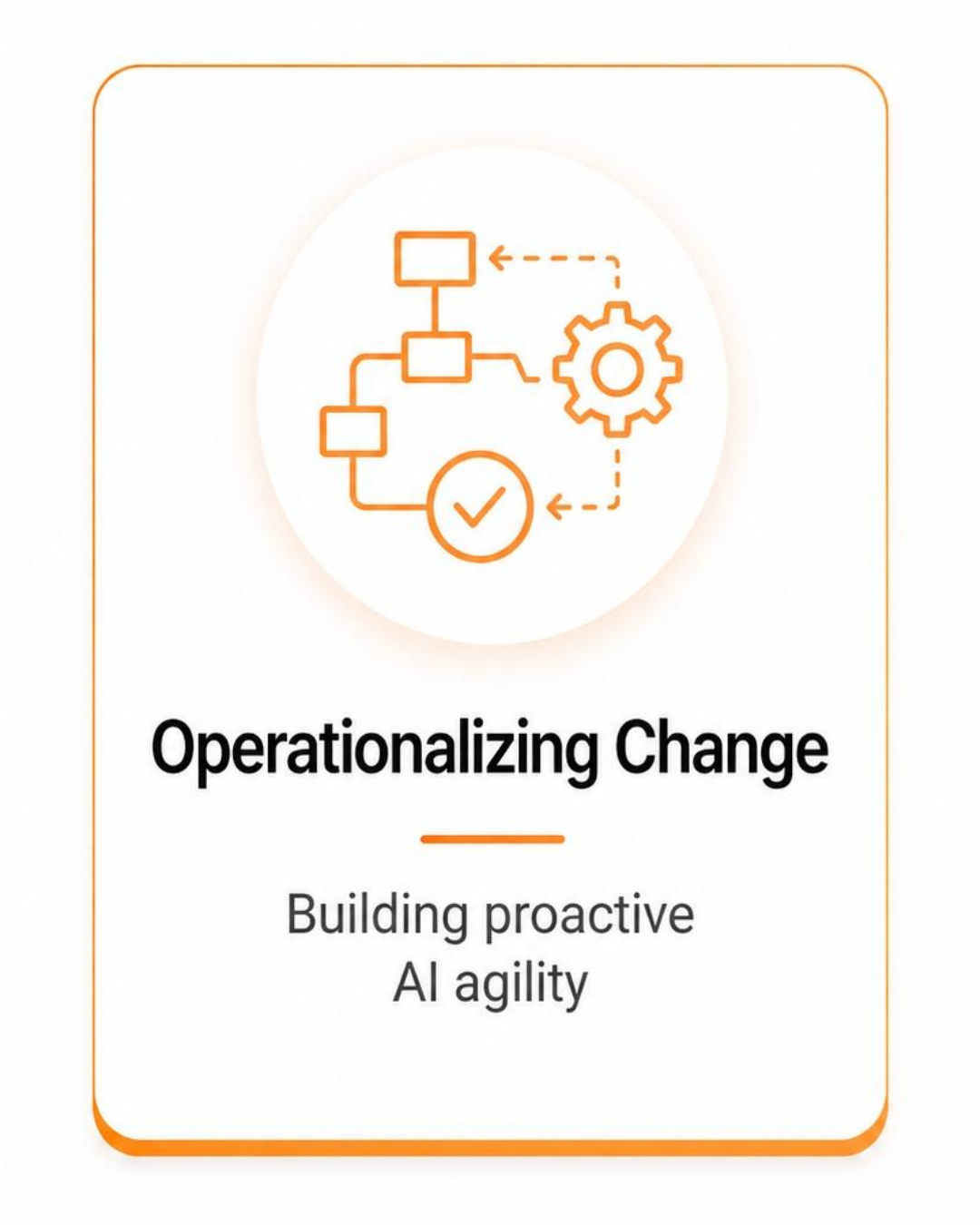
Operationalizing Change
Organizations start building governance and expanding AI adoption, but inconsistencies remain:
- Intake processes exist but are not consistently applied
- AI initiatives operate in parallel with legacy systems
- Scaling requires significant effort and coordination
This stage reflects progress but also introduces friction between innovation and established processes.
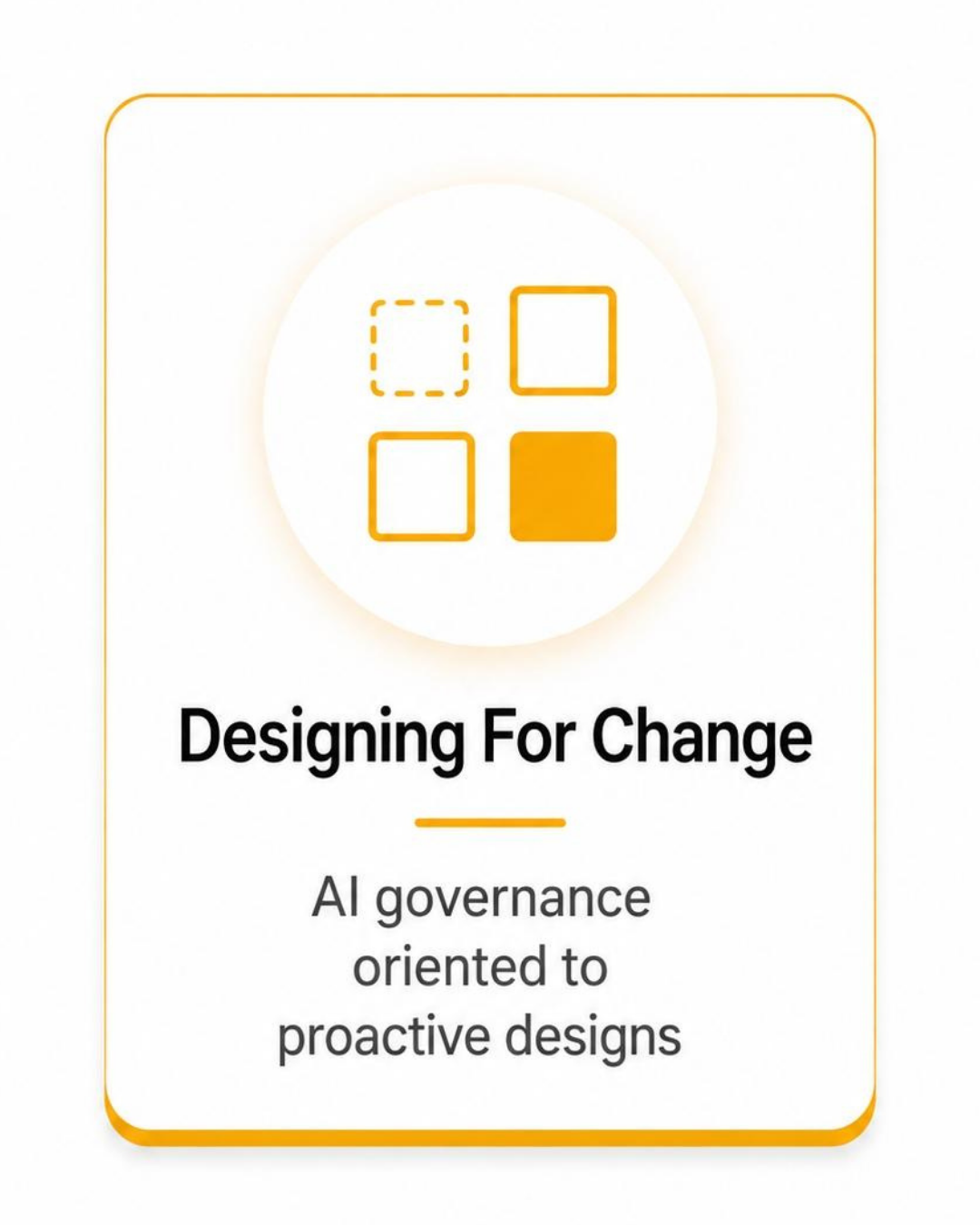
Designing for Change
Organizations reach a level of maturity where agility is embedded into the operating model itself:
- SOPs define outcomes, not just detailed steps
- Technology can evolve without disrupting workflows
- Build, buy and partner decisions are balanced strategically
Most critically, change is no longer reactive. It becomes a continuous capability.
AI Efficiency Without Structural Changes
AI can significantly improve efficiency without driving transformation. For example, AI-powered document generation can accelerate the creation of clinical trial documentation — producing faster, more consistent outputs.
However:
- Underlying processes often remain unchanged
- Roles and responsibilities stay the same
- Workflows continue to follow traditional patterns
The result is improved productivity but limited impact on how work is fundamentally delivered. Automation improves how fast work is done, but agility determines whether work is done efficiently. Without rethinking operating models, AI adoption value remains incremental rather than transformative.
Designing for Change in Life Sciences

Organizations that move beyond incremental gains take a different approach. They do not simply integrate AI into existing systems; they redesign those systems to support continuous evolution.
This change is defined by creating:
Flexible, modular ecosystems:Technology is designed to be interchangeable. Organizations can integrate new tools or replace outdated ones without disrupting delivery.
Outcome-driven processes:Workflows are defined by the outcomes they must achieve, not by rigid step-by-step procedures.
Reimagined roles and responsibilities:AI changes how work is distributed. Experts focus on high-value decisions, while automation handles repeatable tasks. This model allows organizations to evolve alongside technology rather than falling behind it.
AI Operating Models in Life Sciences: Scalable and Governed AI Adoption
The Syneos Health AI Agility Model reinforces that sustained success requires more than technology adoption. It requires a balanced operating model built across three areas:
Foundations: Strong governance, data structures and core systems remain essential but must support flexibility, not restrict it
Partner Ecosystem: Organizations must work across a blend of enterprise platforms and fast-moving AI innovators to access the full spectrum of capabilities
Portfolio Discipline: Continuous evaluation ensures that investments remain aligned with value as technology evolves
Together, these elements enable organizations to scale AI while maintaining control, compliance and long-term sustainability.
From Experimental to Scalable Impact
The implications in clinical development are significant. AI has the potential to reshape how studies are designed, executed and analyzed. Yet these benefits will remain constrained if operating models are not adapted to support continuous change.
That means:
- Shifting from rigid process frameworks to adaptive systems
- Aligning governance with the speed of innovation
- Designing workflows around outcomes rather than tasks
- Embedding flexibility into core delivery models
As more organizations embrace different forms and uses of AI, the gap between the agile and non-agile actors will only widen. And as investments in AI grow, there will be more opportunities than ever to adopt new tools and capabilities.
But the most important question is not which tool to implement next. It is whether the organizations are prepared to change their operating models.
Discover how combining flexible operating models with integrated clinical solutions can help turn AI innovation into long-term sustainability.
Contributor
Matt Harrington
Global Head, Clinical Product
Syneos Health
Related Content



Looking for exclusive insight?