Operational Excellence Is the New Competitive Moat in CAR T Development
As chimeric antigen receptor T-cell (CAR T) therapy moves from scientific breakthrough to clinical reality, sponsors face a new challenge: the bottleneck is shifting from science to execution. Sponsors that treat clinical operations as a strategic capability, rather than a delivery function, will be better positioned to navigate what comes next.
For much of the past decade, the conversation around CAR T centered on scientific innovation. Could engineered immune cells deliver durable responses? Could cell therapy redefine treatment for hematologic malignancies? The field has moved beyond proving that CAR T can work at all.
Seven CAR T-cell products are now approved in the United States, while the operating assumptions surrounding their delivery have changed materially since June 2025, when the FDA eliminated REMS requirements for six established autologous CAR T-cell therapies and streamlined post-infusion monitoring requirements. And the operating model being optimized today may not be the one sponsors need tomorrow.
Explore how Syneos Health helps sponsors navigate the clinical, operational and commercial complexities of CAR T development.
Three Shifts That Reset the Operating Model
First, a major regulatory access constraint was removed. In June 2025, the FDA eliminated the Risk Evaluation and Mitigation Strategy (REMS) programs for the six then-covered BCMA- and CD19-directed autologous CAR T therapies. The change eliminated requirements for certified treatment centers and immediate on-site access to tocilizumab for the affected products.Under REMS, treatment was limited to certified centers. That specific regulatory constraint is gone. What did not go with it is the rest of the access equation: apheresis capacity, critical care rescue, accreditation, financial clearance, payer contracting and manufacturing slot availability all remain. Regulation was the visible constraint. Removing it does not create capacity; it exposes which constraints were always operational.
Second, FDA authors have publicly articulated a higher evidentiary bar for future CAR T development. In a December 2025 JAMA Viewpoint, CBER authors argued for greater reliance on randomized comparative evidence and clinically meaningful time-to-event outcomes in future CAR T approvals, with control arms reflecting current standard of care. The Viewpoint is not formal guidance and carries no binding effect, but it is a consequential signal. A higher evidentiary bar also raises the operational bar. Single-arm response-rate studies can be operationally simpler than randomized CAR T trials against an approved therapy. Randomized CAR T clinical trials against an approved cell therapy are not. Slots must be reserved before randomization, control product must be available and billable at every site, investigators must hold genuine equipoise, and subsequent therapy after progression complicates survival analysis in ways that should be anticipated at design.
And third, the manufacturing model itself may also be changing. Interest in in vivo CAR T, where cellular engineering occurs within the patient, is no longer theoretical. First-in-human data presented in 2026 have demonstrated in vivo CAR T generation and expansion without lymphodepleting chemotherapy. While the datasets remain small and durability is unproven, multiple programs are already exploring how this model could change the logistics of CAR T delivery, and the potential operational implications are significant.
Clinical Operations Has Become a Competitive Advantage
Every CAR T patient follows a coordinated pathway involving cell collection, manufacturing, logistics, conditioning therapy, infusion and long-term monitoring. Vein-to-vein time can still span several weeks for autologous products, and in a heavily pretreated population, treatment delays can carry meaningful progression risk.
Time is not an efficiency metric in this setting. It is a clinical variable. Yet some of the greatest operational challenges occur after manufacturing, according to Kathy Hassig, Therapeutic Area Lead at Syneos Health. "Because CAR T patients generate substantial clinical and safety data, programs depend on rapid data collection, timely monitoring and close collaboration with investigative sites. Data backlogs, delayed source verification and slow query resolution can create downstream quality and safety risks if not addressed proactively."

That coordination problem intensifies as treatment moves outward from academic centers, says Wael Harb, MD, MBA, Global Head of R&D, Medical and Scientific Strategy, Oncology at Syneos Health. "The handoff back to the referring oncologist is where programs quietly lose both data and time. A patient may be infused at one institution and followed for years by another. If that relationship is not designed into the protocol from the beginning, long-term follow-up becomes a collection exercise instead of a continuation of care."
Operational discipline is not adjacent to scientific rigor in CAR T. It is the mechanism by which scientific rigor survives contact with the patient pathway.
Five Questions for CAR T Site Readiness in a Post-REMS Environment
With REMS certification no longer acting as the same regulatory filter, feasibility assessment has to do work that regulation once did. Five questions separate a capable site from an enthusiastic one:
- 24/7 clinical coverage: Are oncology, hematology, pharmacy, apheresis, neurology and critical care escalation available around the clock, or only during business hours?
- Apheresis capacity: Slot availability and realistic bridging plans matter more than a binary yes on capability.
- Accreditation: Is the site FACT accredited, and if not, what is the honest timeline?
- Financial and access readiness: Who pays for commercial comparator product, and can it be billed? Does the payer still require center-of-excellence status even though FDA no longer does?
- Data ownership: Source verification cadence, query turnaround and a named owner for long-term follow-up, agreed before the first patient is consented.
For appropriately selected patients and equipped sites, hub-and-spoke models for CAR T delivery are moving from concept to practice. Prospective data from the OUTREACH study demonstrated the feasibility of outpatient liso-cel treatment at community sites, while a 2026 report from an independent community oncology practice described real-world outpatient CAR T delivery outside an academic or hospital system. What those programs share is not scale. It is disciplined patient selection, defined escalation pathways and named local partners in intensive care, neurology and infectious disease.
The Moat Is Moving
CAR T-cell therapy product acquisition costs are generally measured in the hundreds of thousands of dollars per infusion, while total episode-of-care costs can be substantially higher once hospitalization, monitoring and toxicity management are included. Cost of this magnitude keeps therapy concentrated where infrastructure already exists.
If in vivo CAR T succeeds, it could remove much of the operational infrastructure that has defined autologous CAR T delivery. No apheresis. No chain of identity. No cryoshipper. No vein-to-vein clock. It does not, however, remove the complexity. It migrates the issue toward vector and lipid nanoparticle manufacturing, batch consistency, biodistribution, dose and persistence control, and whatever long-term surveillance regulators ultimately attach to in vivo gene delivery. The advantage relocates rather than disappears: toward site readiness at scale, safety monitoring across centers with no cell therapy heritage, and the ability to execute randomized trials faster than a competitor. The organizations best positioned are not those betting correctly on a single modality. They are those whose operating model can absorb either outcome.
If in vivo CAR T succeeds, it could remove much of the operational infrastructure that has defined autologous CAR T delivery. No apheresis. No chain of identity. No cryoshipper. No vein-to-vein clock. It does not, however, remove the complexity. It migrates the issue toward vector and lipid nanoparticle manufacturing, batch consistency, biodistribution, dose and persistence control, and whatever long-term surveillance regulators ultimately attach to in vivo gene delivery. The advantage relocates rather than disappears: toward site readiness at scale, safety monitoring across centers with no cell therapy heritage, and the ability to execute randomized trials faster than a competitor. The organizations best positioned are not those betting correctly on a single modality. They are those whose operating model can absorb either outcome.
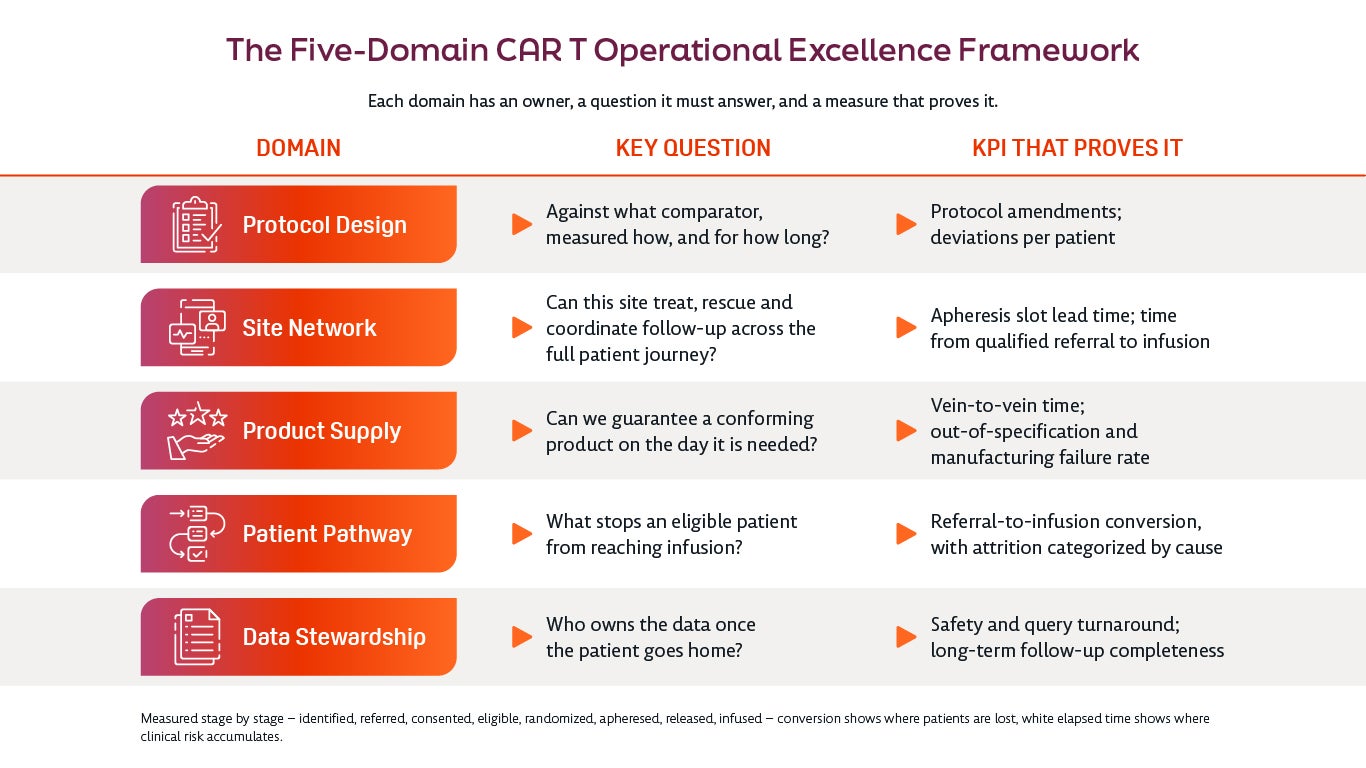
One measure deserves particular attention. Most CAR T programs track site activation and enrollment, the same metrics used in conventional oncology trials. Referral-to-infusion conversion across the CAR T patient journey shows something those metrics cannot: where patients are being lost and where time is accumulating in the pathway. Attrition from progression, payer denial, manufacturing failure and patient choice are different problems with different fixes, and a program that knows only its screen-failure rate cannot tell them apart.
Looking Ahead
The first era of CAR T was defined by proving that engineered cells could produce durable, potentially curative response. The next will be won by compressing the distance between an eligible patient and a safely delivered therapy, while generating evidence strong enough to compete against increasingly effective standards of care. That requires clinical development, manufacturing, site strategy, access and commercialization to operate as one system rather than as adjacent functions handing work to one another.
Let us help you build an operating model ready for what comes next in CAR T.
Contributors
Related Content



Looking for exclusive insight?