Real World Evidence
Real world evidence (RWE) and late phase research services for the full drug development lifecycle

In the real world, patients navigate often complicated and increasingly fragmented journeys to better health – producing vast amounts of valuable data along the way, from diagnosis to treatment and beyond.
Real world evidence (RWE) reveals how therapies perform and medicine is practiced in the real world, informing decisions that matter to regulators, payers and providers. RWE is derived from real world data (RWD), which is healthcare information drawn from electronic health records (EHR), claims databases, patient registries and wearable devices. Unlike the information generated by randomized controlled trials (RCTs), RWE captures the full breadth of patient populations, treatment settings and long-term outcomes that regulators, payers and prescribers increasingly require.
As a fully integrated CRO, Syneos Health designs and executes RWE and late phase research globally, with operational experience in ~70 countries and delivery capabilities that scale across study designs, geographies and data complexity. Our teams align RWE studies and RWD analyses to FDA’s Real-World Evidence Program (established under the 21st Century Cures Act) and EMA post-authorization requirements (like Post-Authorization Safety Studies (PASS) or Post-Authorization Efficacy Studies (PAES)). They apply an epidemiology-led, quality-by-design approach to support regulator-ready, reproducible evidence.
RWE Expertise at a Glance:
160+
global RWLP employees
390
studies since 2021
9,500+
sites engaged
188,000+
patients enrolled across ~70 countries
Our dedicated RWLP organization includes 220+ global subject matter experts and has delivered 370 studies since 2021, engaging 8,300+ sites and enrolling 177,500+ patients across ~70 countries.

How we design fit-for-purpose RWE and late phase studies
At Syneos Health, we design fit-for-purpose real world evidence and late phase studies to answer the questions that matter most to regulators, payers and clinicians. We combine epidemiology-led study design with a quality-by-design approach to proactively manage bias, reduce uncertainty and deliver regulatory-grade evidence stakeholders can trust.
Our teams provide end-to-end scientific leadership, from protocol development through final reporting and publication, paired with global operations that scale across geographies and care settings.
We start by identifying the evidence gaps to determine what regulators, payers or clinicians still need to know about a product. From there, we select the study design and data sources best suited to answer those questions.
Real World Late Phase Integrated Study Solutions
Once a therapy is approved, questions may remain about safety, effectiveness, value or long-term outcomes. No matter the need, Syneos Health can shape and execute late phase studies to generate the evidence you need to move forward with confidence.
Read more about our integrated study solutions:
Prospective continuation studies that allow patients from earlier trials remain on therapy while generating long-term safety, survival and outcomes data. Rollover studies require seamless transition from the parent trial, sustained patient engagement over time and consistent data collection across studies and indications. Syneos Health brings deep oncology time-to-event expertise, scalable rollover platforms that can consolidate multiple parent studies and patient-centric engagement strategies for long-duration participation.
Open-label extension (OLE), long-term follow-up (LTFU) and long-term extension (LTE) studies are prospective, longitudinal, follow-on studies that extend parent trial participation to evaluate durability of response and long-term safety and efficacy. Extension studies can be operationally complex, with long timelines, high patient attrition risk and increased site burden, particularly in rare disease.
Syneos Health designs retention-focused, low-burden studies and lean operational models to protect data integrity while reducing site and monitoring burden and sustaining long-term participation. We also enable consolidated rollover programs that bring multiple parent studies into a single, streamlined platform that can reduce operational complexity, lower costs and improve continuity of long-term data collection.
Late-phase interventional studies conducted after pivotal trials to generate additional effectiveness and safety evidence. In particular, when a therapy is granted accelerated (FDA) or conditional (EMA) approval, sponsors must execute confirmatory trials to verify clinical benefit and meet regulatory requirements.
These studies require alignment between regulatory expectations and real-world value. Syneos Health brings both clinical development and commercialization expertise to design comparative effectiveness and hybrid clinical/real-world approaches that generate robust evidence for approval, access and adoption.
Prospective observational platforms, with potential retrospective components, that collect longitudinal RWD to understand natural history, outcomes, safety and disease progression, and to enable future comparator development such as external control arms (ECAs). Registry studies often struggle to deliver consistent, high-quality data over time, particularly across regions and data sources. Syneos Health builds scalable, governance-ready registry platforms and develops high-quality, analysis-ready datasets for submissions and comparator strategies, including the longest-running multi-sponsor antiretroviral pregnancy registry in the industry.
Prospective or retrospective non-interventional studies that generate regulatory-grade RWE from RWD to evaluate safety, effectiveness, utilization and outcomes in routine practice, including post-authorization commitments. Observational studies often face challenges around bias, data variability and ensuring results are credible and actionable. Syneos Health applies epidemiology-led methods to mitigate bias, leverages deep experience across global EMR, claims and linked data sources and delivers submission-ready evidence accepted by regulators and HTA bodies.
Our late phase research capabilities: bridging clinical trials and real-world practice
Late phase research encompasses the full spectrum of peri-approval and post-approval studies designed to generate evidence about a medicine's effectiveness, safety and value in routine clinical practice. While Phase I–III trials establish safety, efficacy and benefit-risk profiles under controlled clinical conditions, late phase research — including Phase IV studies, post-marketing studies and observational research — answers the questions those trials often cannot: How does this therapy perform across broader patient populations? What happens over years, not months? How does it compare to existing standards of care in real-world settings?
The Syneos Health Late Phase Research team operates as a fully integrated unit, combining epidemiologists, biostatisticians, regulatory scientists and outcomes researchers to design and execute studies across the complete late phase spectrum.
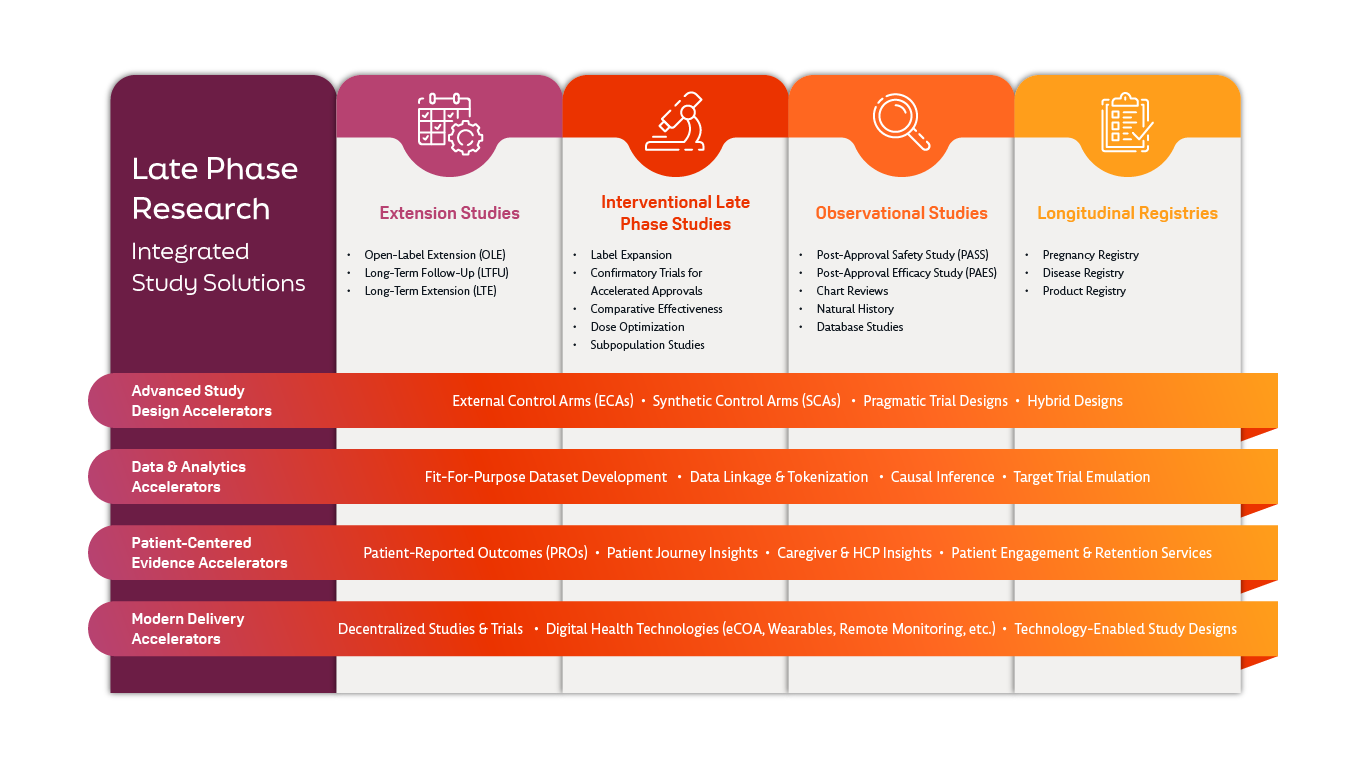
Our Capabilities
- Phase IIIb Trials: post-pivotal interventional studies that generate additional effectiveness, safety, dosing and comparative outcomes evidence to support label expansion, market access and broader clinical adoption
- Confirmatory Trials: post-approval studies required following accelerated (FDA) or conditional (EMA) approvals to verify clinical benefit and satisfy regulatory commitments
- Open Label Extension (OLE) Studies: follow-on studies that remove treatment blinding after a controlled trial phase, allowing patients to continue therapy while generating additional long-term safety and efficacy data
- Long-Term Extension (LTE) Studies: extended-duration follow-on studies that evaluate long-term durability, safety and treatment persistence over multiple years
- Long-Term Follow Up (LTFU) Studies: structured post-treatment surveillance studies required by regulators for gene therapies, cell therapies and other high-risk interventions to monitor delayed or long-term safety outcomes
- Managed or Expanded Access Programs: controlled treatment pathways that provide investigational therapies to patients before formal approval while supporting operational continuity and real-world insight generation
- Non-Drug Interventional Studies: prospective clinical studies evaluating devices, diagnostics, procedures, digital therapeutics or standard-of-care interventions in real-world clinical settings
- Post Authorization Safety Studies (PASS): EMA-required post-approval studies that evaluate safety in real-world patient populations after marketing authorization.
- Post Authorization Efficacy Studies (PAES): EMA-required or commitments-based studies confirming effectiveness in broader populations beyond the original trial cohort; may be imposed at time of conditional marketing authorization
- Patient and Disease Registries: longitudinal databases collecting structured patient data for regulatory, epidemiological or outcomes research purposes. Syneos Health designs and operates disease, product and pregnancy exposure registries as part of our global RWLP portfolio.
- Natural History Studies: prospective or retrospective studies characterizing disease progression and standard of care in the absence of the investigational therapy; frequently required as context for single-arm trials in rare disease and oncology indications
- Retrospective and Prospective Chart Reviews: structured analyses of patient medical records used to evaluate treatment patterns, clinical outcomes, safety signals and real-world utilization across defined patient populations
- Time and Motion Projects: observational workflow studies that measure healthcare resource utilization, treatment burden and clinical process efficiency to support HEOR, value demonstration and operational decision-making
With more than 30 years of experience supporting pregnancy exposure research, including management of the Antiretroviral Pregnancy Registry, Syneos Health has deep expertise in FDA Pregnancy Registry guidance compliance and EMA PASS requirements for reproductive safety. As part of our broader RWLP registry capability (which also includes patient, disease and product, registries), we generate RWE that supports label updates, risk management programs (RMPs) and post-marketing regulatory commitments across global study footprints.
Health economics and outcomes research (HEOR) evaluates the clinical, economic and humanistic value of healthcare interventions to inform payer, HTA and market access decision-making. As part of our integrated late phase research and RWE offering, Syneos Health delivers HEOR services that connect clinical evidence to market access strategy.
Evidence and Efficiency Accelerators
No two evidence generation challenges are alike. The right solution depends on the scientific question, regulatory objective, patient population, timeline and available resources. Rather than applying the same model to every project, Syneos Health combines advanced study design approaches, data and analytics capabilities, patient-centered methodologies and modern delivery models to build fit-for-purpose solutions tailored to each research objective.
By selecting the right mix of accelerators for each situation, we help sponsors generate robust evidence efficiently while minimizing unnecessary complexity, burden and cost.
- Advanced Study Design Accelerators: Not every research question can be answered with a traditional randomized controlled trial. Syneos Health uses external and synthetic control arms to augment single-arm trials with fit-for-purpose comparative evidence, as well as pragmatic trial designs and hybrid approaches that reduce enrollment challenges, lower site burden and answer important research questions without introducing unnecessary complexity. The result is a study designed around the realities of your disease area, patient population and timeline.
- Data & Analytics Accelerators: Better evidence starts with better data. Syneos Health takes a source-agnostic approach to assembling fit-for-purpose datasets from across a global ecosystem of partners, applying advanced analytics, causal inference and tokenization strategies to generate decision-ready insights. The result is a reusable evidence foundation that can answer today's research questions while supporting future regulatory, clinical and commercial needs.
- Patient-Centered Evidence Accelerators: Some of the most important evidence cannot be found in a medical record. Syneos Health uses patient-reported outcomes (PROs), patient journey research and caregiver and healthcare provider insights to capture quality of life, treatment burden, adherence and other outcomes that traditional clinical and real-world datasets often miss. To support long-term participation and data completeness, we can pair these approaches with Patient Concierge Services, the PatientGO™ app and behavioral science expertise that help improve recruitment, retention and patient engagement throughout the study lifecycle.
- Modern Delivery Accelerators: Generating high-quality evidence should not create unnecessary burden for patients or sites. Syneos Health combines decentralized approaches, digital health technologies, remote monitoring, eCOA and technology-enabled study designs to make participation more accessible while streamlining study execution. These capabilities enable objective, near real-time data capture from patients in routine settings, providing earlier visibility into safety, adherence and treatment outcomes while improving operational efficiency.

RWE vs. Late Phase Research: Understanding the Relationship
Real world evidence (RWE) and late phase research are closely related but not identical. RWE refers to the evidence generated from real world data — it can be produced at any stage of development, including pre-approval (e.g., for natural history studies or external control arms). Late phase research refers to the broad range of peri-approval and post-approval studies designed to generate evidence beyond pivotal clinical trials. RWE generation is common across many of these study types, but can also occur earlier in development to support activities such as natural history studies, external control arms and trial planning.
FAQs
Respiratory programs must align device validation, variable endpoints and symptom fluctuations with real‑world feasibility. Our integrated model unifies scientific design, Real world data (RWD) refers to the raw data collected outside of controlled clinical trials — from electronic health records (EHR), insurance claims, disease registries and patient-reported outcomes. Real world evidence (RWE) is the clinical evidence generated through analysis of that data. Put simply: RWD is the input; RWE is the output that informs regulatory, payer and clinical decisions.
Randomized controlled trials (RCTs) test efficacy in a controlled population under ideal conditions. Real world evidence reflects how a medicine performs across broader and more representative patient populations in routine clinical practice — including elderly patients, those with comorbidities and patients on concomitant medications that would have been excluded from a trial. RWE does not replace RCTs but complements them by answering questions about long-term safety, comparative effectiveness and real-world value that trials are not designed to answer.
Late phase research is a broad term covering all post-approval and peri-approval evidence generation activities, including Phase IV studies, post-marketing studies, observational research and health economics and outcomes research (HEOR). Phase IV refers specifically to post-approval interventional studies conducted after regulatory approval. Late phase research is the wider category — it encompasses Phase IV trials but also includes non-interventional studies, registries and RWD analyses that do not meet the definition of a clinical trial.
Under the FDA's Real-World Evidence Program (established by the 21st Century Cures Act) and EMA's PASS/PAES post-authorization frameworks, sponsors can use RWE to support new indications, post-approval safety monitoring, comparative effectiveness evaluations and other regulatory decision-making needs. Syneos Health provides end-to-end RWE regulatory submission support including study protocols, statistical analysis plans and dossier preparation aligned to current FDA and EMA guidance.ty.
We design and execute the full spectrum of observational and late phase study types: Post Authorization Safety Studies (PASS), Post Authorization Efficacy Studies (PAES), pragmatic clinical trials, patient and disease registries, natural history studies, retrospective and prospective chart reviews, RWD database analyses, external control arms (ECAs) and HEOR. Study selection is driven by the evidence gap and regulatory or payer requirements.
We take a source-agnostic approach, selecting data based on quality, coverage and fit. Sources include EHR networks, medical claims databases, prospective patient registries, retrospective chart data, wearables and digital health devices and patient-reported outcomes. Where needed, we link multiple data sources to maximize population coverage.
The European Medicines Agency (EMA) may require a Post Authorization Safety Study (PASS) as a condition of marketing authorization when pre-approval data is insufficient to fully characterize a product's safety profile — particularly for long-term effects, use in vulnerable populations or rare but serious adverse events. PASS requirements are specified in the Risk Management Plan (RMP) and assessed by PRAC. Syneos Health has designed and executed PASS studies across multiple therapeutic areas to meet these regulatory obligations.
Related Content



Looking for exclusive insight?