Responsible AI by Design: The Principles Guiding AI at Syneos Health
How responsible AI principles help ensure that innovation, trust and accountability advance together.
Artificial intelligence (AI) is changing how work gets done across the life sciences industry. Across research, development and commercialization, organizations are using AI to improve efficiency, strengthen decision-making and augment human expertise.
As AI becomes more deeply embedded in business and operational processes, governance becomes just as important as innovation.
In highly regulated environments that rely on sensitive data, scientific rigor and human judgment, responsible AI cannot be treated as a final review step. Accountability, risk management, security, data governance and oversight must be considered throughout the AI lifecycle.
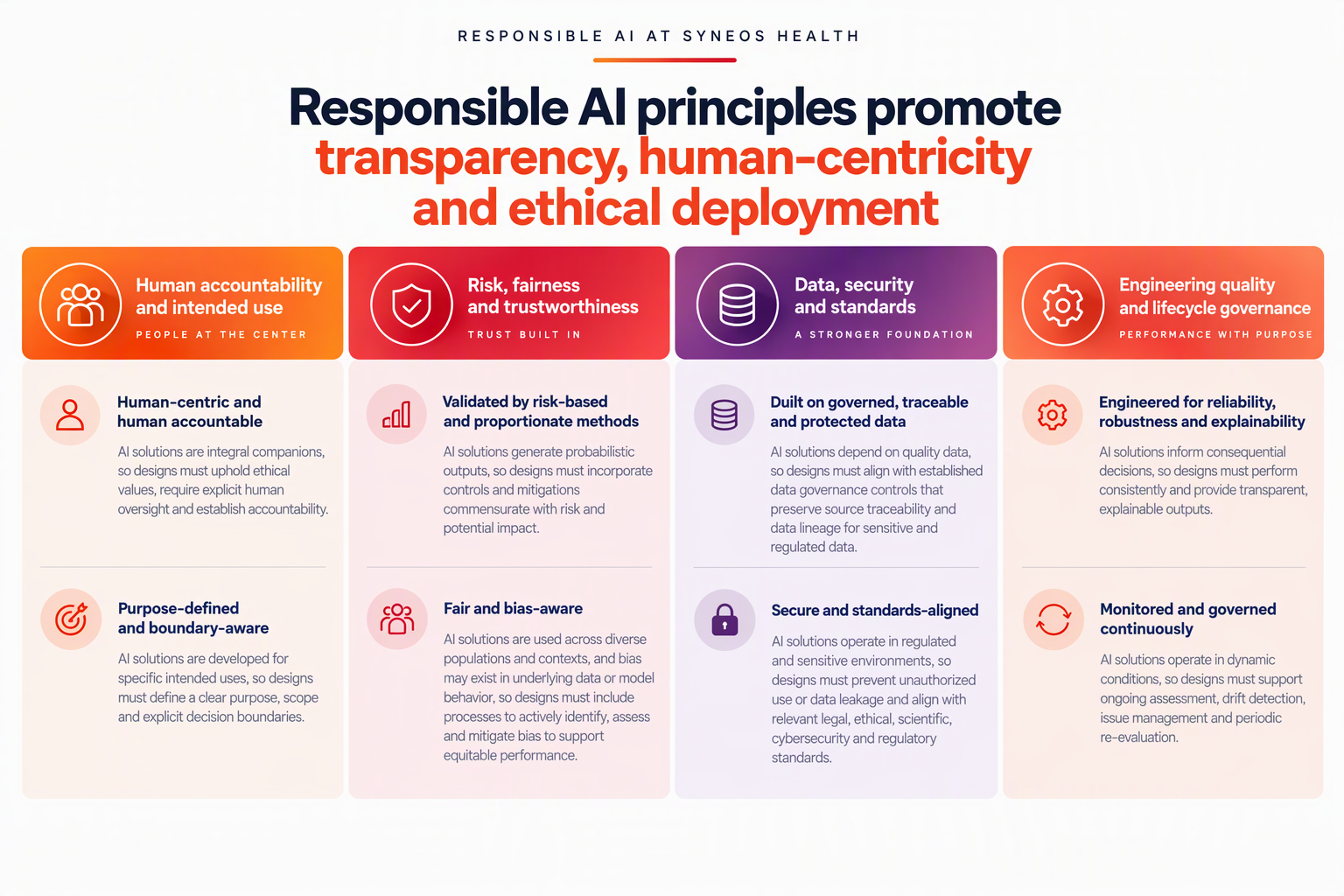
That is why the Syneos Health Responsible AI Guiding Principles set expectations for how teams develop, deploy and govern AI. These principles reflect four commitments: keeping people and purpose at the center of decision making; managing risk and bias appropriately; protecting the data and environments on which AI depend; and maintaining ongoing governance throughout the AI lifecycle.
Learn more about how Syneos Health is advancing AI-enabled innovation across clinical development and commercialization.
Human Accountability Starts With Purpose
Every discussion about responsible AI should begin with accountability.
At Syneos Health, we view AI as a tool that supports human expertise, not one that replaces human responsibility. Regardless of how sophisticated an AI capability becomes, accountability for decisions and outcomes remains with our experts.
That belief shapes AI development from the outset. We begin with a clear purpose for each solution, define where it should and should not be used and identify the decisions that require human judgment. Those boundaries guide the solution’s design and how people use it.
Managing Risk, Bias and Trustworthiness
Once we define a solution's purpose, we assess its risk profile and the potential impact of errors. That assessment determines the level of validation, oversight and governance review the solution requires. The controls should reflect the risk of the specific use case.
We also examine whether a solution performs fairly across the populations and settings where it will be used. Bias can arise from the data, the model or how a solution is implemented, so we work to identify, measure and mitigate it. Together, these practices help us build trust in a solution’s performance for its intended purpose.
Our AI Trust Scoring Tool supports this approach by providing structured evaluations of AI outputs. Guided by the NIST AI Risk Management Framework, it assesses measures such as response relevance, faithfulness to source information and potential bias or harmful content, as appropriate to the use case. These evaluations complement human review and help teams identify areas for improvement.
Responsible AI Requires Trusted Data and Secure Foundations
Responsible AI is not a one-time approval event. AI solutions operate in dynamic environments where data, operating conditions and user interactions can change over time. Reliability, robustness and explainability therefore need to be engineered into systems from the outset, supported by ongoing monitoring and governance after deployment.
For us, that means continuing to assess whether a solution performs as intended and remains appropriate for its defined purpose. We watch for changes in performance and data quality, emerging bias and use beyond the solution’s defined boundaries. When issues arise, we investigate them and reassess whether the solution or its controls need to change.

Technology Evolves. Principles Endure.
AI is opening up exciting possibilities across the life sciences industry. It can help teams work more efficiently, respond as needs change and keep progress moving from clinical development through commercialization. We are eager to explore what more it can make possible alongside our customers and partners.
Realizing that potential is a responsibility shared across Syneos Health. Our Responsible AI Guiding Principles give colleagues in technology, security, clinical delivery, commercialization and other functions a common foundation for deciding where AI belongs, how to govern it and when to revisit those decisions.
Customers trust us with sensitive information and consequential work. We take that trust seriously. As we help our partners keep pace with innovation and shape what comes next, we intend to earn their confidence through the care, judgment and accountability we bring to every use of AI.
Explore the governance considerations behind agentic AI in clinical development.
Contributors
Mike Montello
Chief Digital & Information Officer
Syneos Health
Charley Newberry
Chief Information Security Officer
Syneos Health
Related Content



Looking for exclusive insight?